History - Ancient history - Writing systems - Mesopotamia, Persia and Phoenicia

How did scribes in Mesopotamia make the characteristic wedge-shaped marks on damp clay tablets?

Correct!
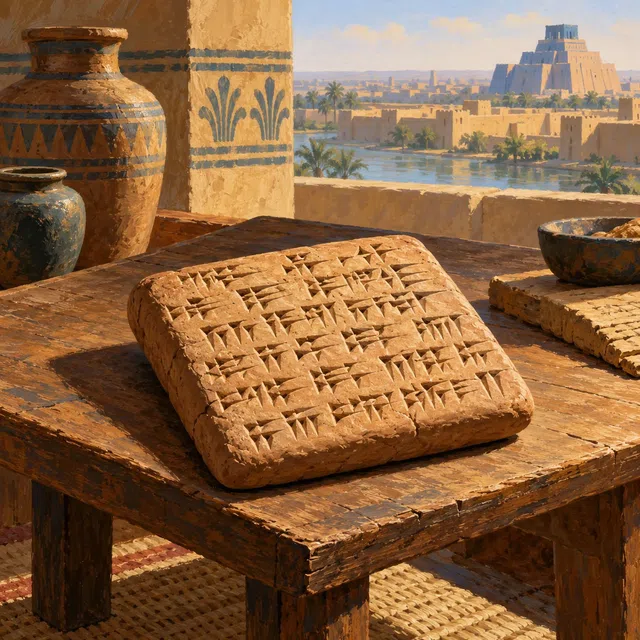
The characteristic wedges were made by pressing a stylus into clay that was still soft. A cut piece of reed was suitable as a writing tool. Changing the angle of the tip produced impressions pointing in different directions, which were combined into signs. Here, the shape of the sign is closely linked to the tool and writing surface. No ink was needed for the tablet. A tablet that had already dried or been fired could not have been written on in the same way with a reed stylus. Cuneiform was not a single spoken language but a writing system used for different languages. Nor was every cuneiform inscription on a clay tablet: signs could, for example, be chiseled into stone. This question specifically concerns writing on damp clay.