Science - Experiments and research - Ancient Egypt - Architecture

Which particles does the ScanPyramids research project use to investigate the interior of the ancient Egyptian Great Pyramid?

Correct!
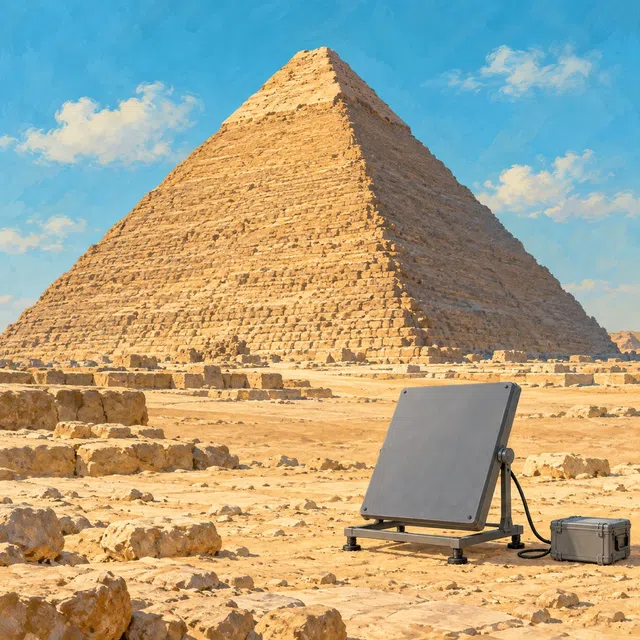
ScanPyramids uses muons. These particles form in the atmosphere through reactions triggered by cosmic rays. Some reach the ground and can also penetrate thick layers of rock. Researchers therefore need no particle source aimed at the pyramid: they use detectors to measure naturally arriving particles. The number of muons reaching a detector from a particular direction depends in part on how much material lies along their path and how dense it is. If there is a void, more particles can arrive than through continuously dense stone. Many measurements, compared with models, provide clues to the internal density distribution. This method is called muon radiography. In 2017, the team reported a previously unknown large void above the Grand Gallery. The publication gave a minimum length of 30 meters and confirmed the signal with three different detector techniques. Such a signal is not a photograph of a treasure chamber: the measurement alone reveals neither the contents nor the void's original purpose. The answer illustration shows one example particle track. Detecting a void, however, requires statistical analysis of many particles.