Nature and environment - Climate and weather - Atmospheric phenomena - Sunlight

Which particles produce a typical large 22-degree halo around the sun in thin high clouds?

Correct!
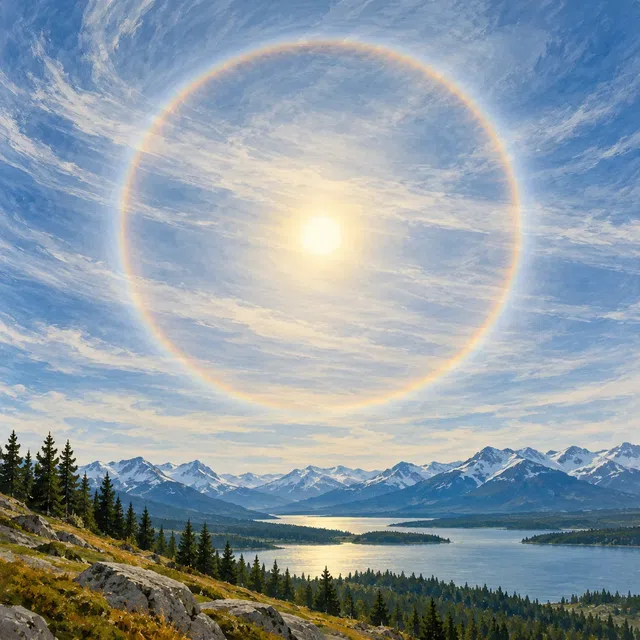
A typical 22-degree halo forms when light is refracted by hexagonal ice crystals in the air. Such crystals occur, for example, in thin high cirrus or cirrostratus clouds. The ring is centered on the sun; the moon can produce a corresponding halo too. As light passes through suitable side faces, the crystals act like tiny prisms. The common light path gives a minimum deviation of about 22 degrees. This angle describes the ring's radius in the sky, not its distance in kilometers. A halo is different from a rainbow or a corona close around the sun. Those phenomena involve different particles or optical mechanisms. A halo alone does not guarantee any particular weather development, even though high ice clouds can appear ahead of a front.