History - Ancient history - Pyramids - Architecture - Mesoamerica

How did the structures nested inside many Mesoamerican temple pyramids come about?

Correct!
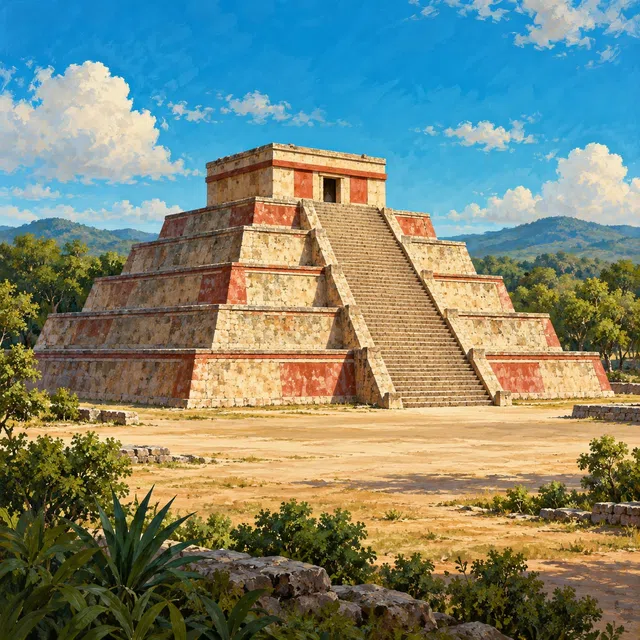
Many Mesoamerican temple pyramids were built over as time passed. Builders constructed a larger new building around and above an older one. Parts of the earlier structure thus survived inside. Repeated enlargements could produce several nested structures. The Great Pyramid of Cholula in present-day Mexico is an example of such successive building phases. Its enormous form did not arise in a single construction phase. Archaeological investigations have identified older buildings and facades within later enlargements. This principle does not mean that all Mesoamerican pyramids have the same structure, or that every surviving predecessor remained complete or unchanged. Builders could remove, alter, or fill in parts. The answer illustration simplifies the principle to three differently colored structures; their number and colors do not represent a particular archaeological finding.