Cars and mobility - Vehicles and brands - Steam locomotives - Mechanical engineering

How does a conventional steam locomotive transmit the force of steam to its driving wheels?

Correct!
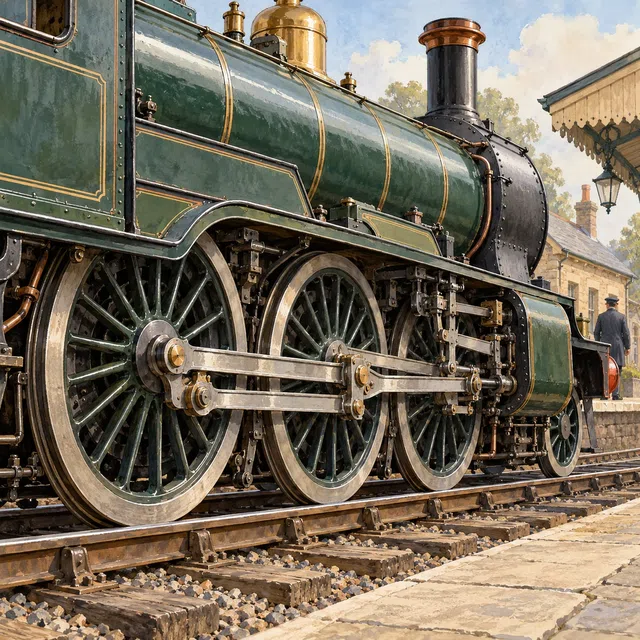
Steam moves pistons inside the cylinders. Rods and crankpins transmit their back-and-forth motion to the driving wheels. This converts linear motion into the rotation that moves the locomotive and its train. Heat first provides the energy needed to generate steam in the boiler. Valves control when steam enters and leaves the cylinders. The boiler, cylinders, and running gear therefore perform different tasks within the same machine. The question concerns the widely used piston design. Special steam drives and experimental designs also existed. However, the visible connecting and coupling rods on conventional steam locomotives are a direct expression of this basic mechanical principle. Not every external rod directly connects a piston to a wheel.