Animals - Animal types and traits - Oceans - Sponges

How does the deep-sea harp sponge Chondrocladia lyra hold small prey animals?

Correct!
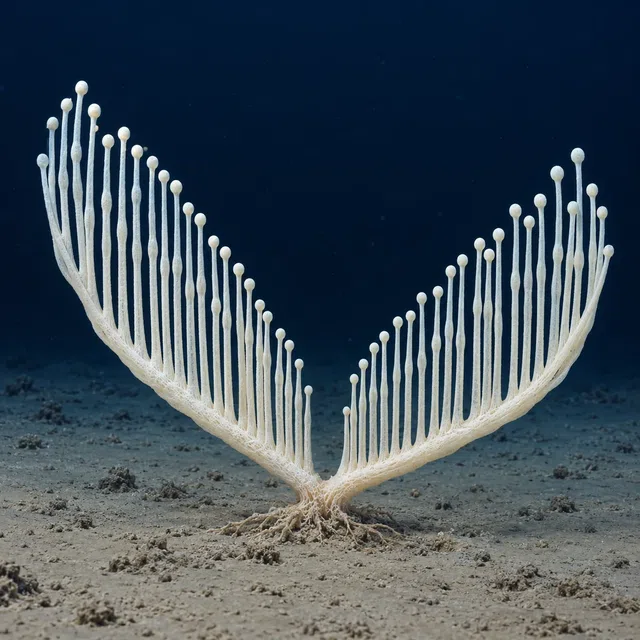
The harp sponge's upright branches carry tiny hook-shaped skeletal elements. Small crustaceans carried toward the sponge by currents can become entangled in them. The capture mechanism can be compared to a hook-and-loop fastener: fine structures catch on one another. After capture, the sponge covers the prey with a thin layer of tissue and begins to digest it. It needs neither a mouth with jaws nor movable hunting arms. The harp sponge remains anchored to the seafloor and uses its branched surface as a trapping structure. Many other sponges feed by pumping water through their bodies and filtering bacteria and small food particles from it. Carnivorous sponges show that this animal group also includes other ways of feeding. The harp sponge is not the only predatory species. Its shape resembles a harp or lyre: numerous thin branches rise from a branching base. The enlarged surface may allow more contact with food drifting past. The small rounded tips also play a role in reproduction; they are neither mouths nor glowing lures.