
Animals - Animal types and traits - Oceans - Cephalopods
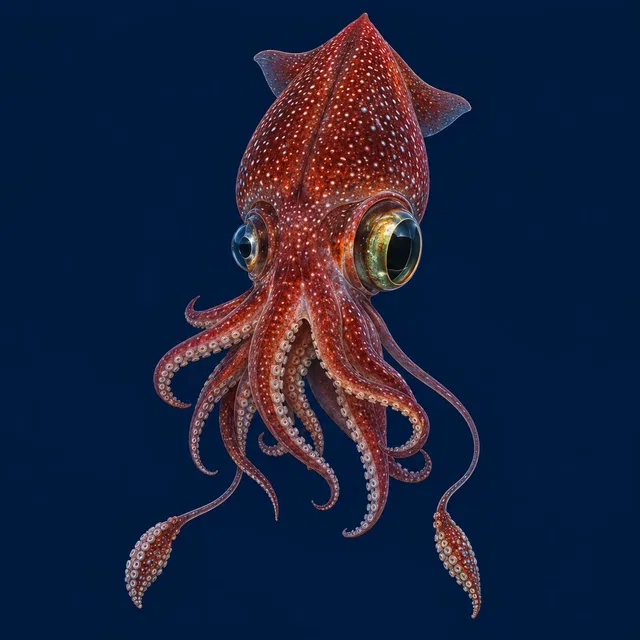
Adult strawberry squid (Histioteuthis heteropsis) have one large eye and one small eye. Which typical division of visual tasks explains this difference?

Correct!
In the strawberry squid Histioteuthis heteropsis, the large left eye is mainly specialized for looking into the faint remaining light above the animal. Prey can stand out there as dark silhouettes. The smaller right eye tends to look downward, searching for points and flashes of light in the darker surroundings. These may come from prey or potential predators. In the ocean's twilight zone, viewing conditions differ greatly with direction. Faint sunlight still arrives from above, while light signals from living organisms stand out farther below. This self-produced glow is called bioluminescence. The same eye design is therefore not ideal for both tasks. The larger eye has a partly tubular shape that increases its sensitivity to dim light. Its lens also often has a yellowish tint. The unequal eyes are thus an adaptation to different lighting conditions. Researchers studied underwater videos and used models of vision. Their findings fit the observed tilted body posture and the different viewing directions. This division of tasks describes a specialization; it does not mean that each eye can perceive only a single kind of light signal.
Source: MBARI: Strawberry squid