Animals - Animal types and traits - Oceans - Fish

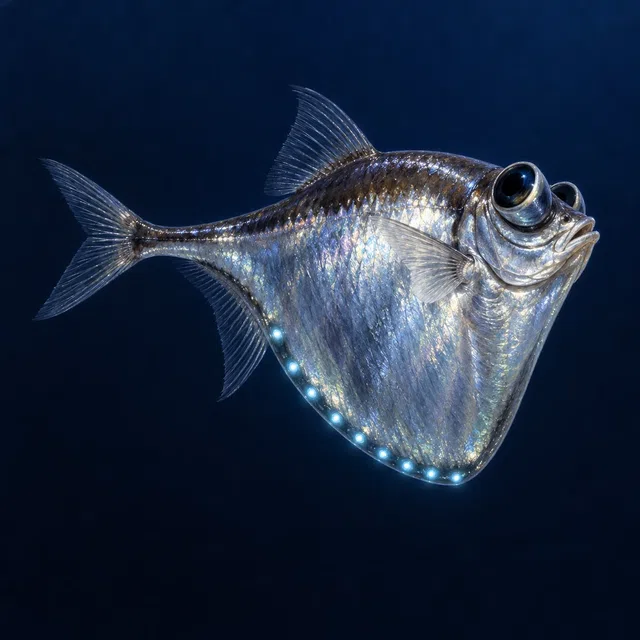
Marine hatchetfish have rows of small light-producing organs along their bellies. What is this light mainly used for?

Correct!
Belly light helps marine hatchetfish hide their dark silhouettes. In the ocean’s twilight zone, faint light still penetrates from above. A predator swimming below a fish and looking upward could see its body as a dark outline against this brighter background. The light-producing organs along the belly counteract this contrast. They emit bluish light downward, and the fish can adjust its brightness to the faint light coming from above. Its underside then stands out less against the background. This form of camouflage is called counterillumination. The right amount of light is essential: a particularly bright belly would itself be conspicuous. The camouflage works when the emitted light matches the background. It can make the fish harder to detect from a predator’s viewpoint below, but does not make it completely invisible from every direction. Marine hatchetfish have strongly laterally flattened bodies and large, upward-facing eyes. Their unusual appearance suits life in dimly lit open water. Other animals in this ocean zone also use counterillumination for protection.