Animals - Animal types and traits - Oceans - Arthropods
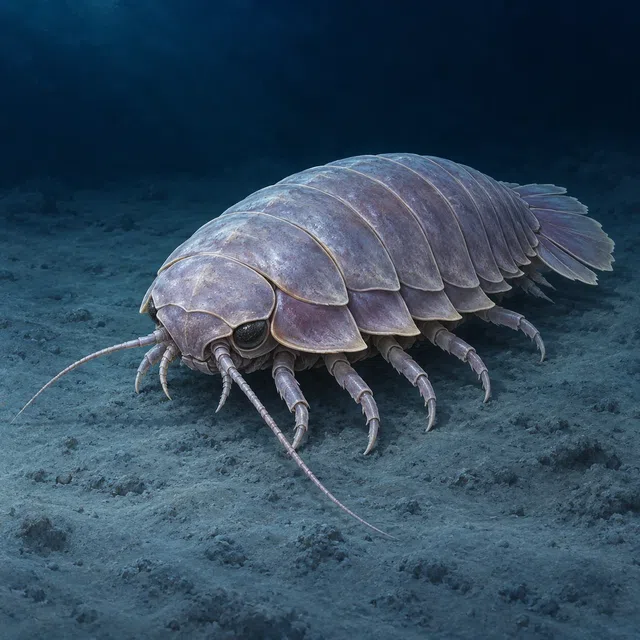
The deep-sea animal shown belongs to the genus Bathynomus. Which of these small land animals is its closest relative?

Correct!
Bathynomus is the genus of giant isopods. They are related to the small woodlice found under damp wood or stones. Both belong to the order Isopoda. Isopods are crustaceans. Their shared body plan can be seen in the segmented body, overlapping back plates, and jointed legs. Adults have seven pairs of walking legs, or 14 walking legs in total. The hard outer covering forms an exoskeleton. Giant isopods also have strikingly large, dark eyes and long antennae with which they sense their surroundings. The size differences are considerable: some giant isopods grow to more than 30 centimeters long. An ordinary woodlouse remains much smaller. The animals in the comparison image are therefore enlarged separately and are not shown at the same scale. Giant isopods live on the seafloor. There they find, among other food, remains of fish and other animals that sink from upper water layers. Their body structure and way of life are adapted to this habitat. Many details of their behavior in the deep sea are still being studied.