Animals - Animal types and traits - Oceans - Sponges

What material mainly makes up the fine skeletal spicules of the deep-sea sponge Euplectella?

Correct!
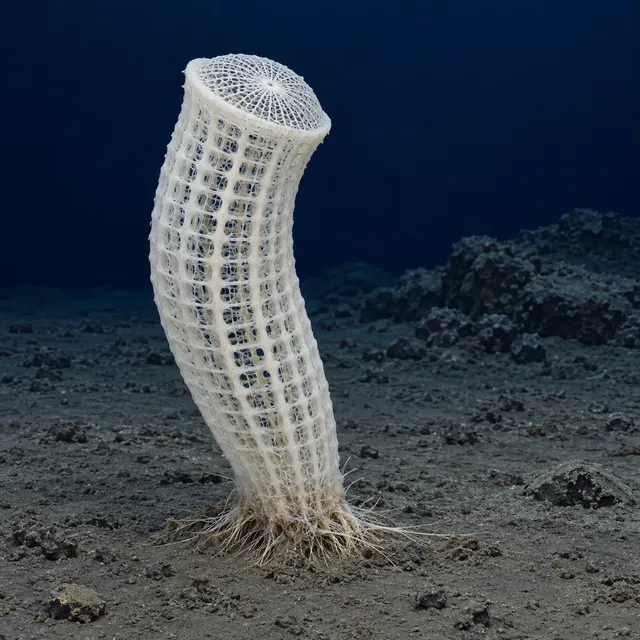
The skeletal spicules of Euplectella consist mainly of silica, or silicon dioxide. This biologically formed material contains water and has a disordered, glass-like structure. Euplectella therefore belongs to the animals known as glass sponges. The fine skeletal needles are called spicules. They join together into a delicate framework. In Euplectella, this forms a basket-shaped body with a regular lattice strengthened by diagonal structures. Both the material and its arrangement contribute to stability. The individual elements also have a finely organized internal structure containing organic components. Such a sponge is an animal, rather than a lifeless glass object. Living tissue is as much a part of its body as the supporting skeleton. Sponges obtain food by filtering small organisms and particles from water. The framework may remain after the living tissue has disappeared. The material resembles glass, but is neither ordinary window glass nor a cage assembled from quartz crystals. The combination of silica and biological architecture also makes these animals interesting to materials researchers.