Dinosaurs & Prehistory - Dinosaurs - Amargasaurus - Sauropods - Dinosaur anatomy - Cretaceous
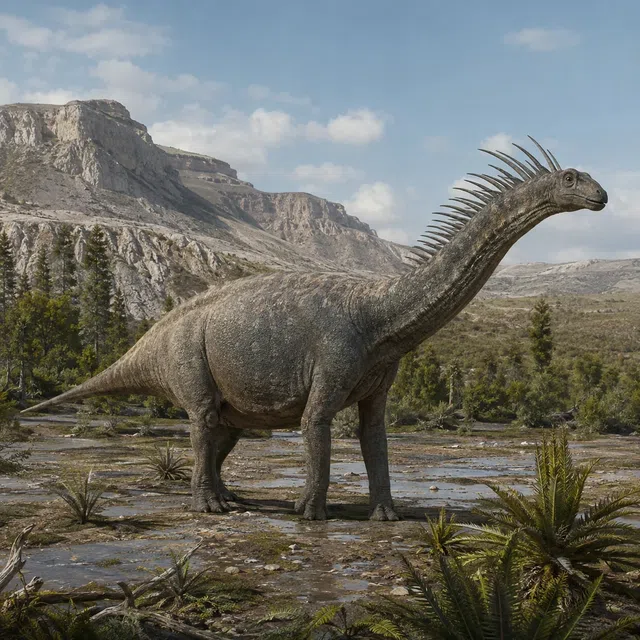
What formed the two prominent rows of long structures on the neck of Amargasaurus?

Correct!
Amargasaurus cazaui was an unusual sauropod from the Early Cretaceous of Argentina. Its most striking feature was the extremely elongated neural or spinous processes of its vertebrae. The cervical vertebrae were deeply bifurcated, giving rise to two long processes each, forming a characteristic double row along the neck. The original scientific description stated that some of these extensions were approximately four times as long as the respective vertebral bodies. This bizarre anatomy belongs to the family Dicraeosauridae, whose members generally have forked and elongated spinous processes. However, this development was particularly extreme in Amargasaurus. What the whole thing actually looked like on a living animal is less certain. Reconstructions show Amargasaurus partly with one or two skin sails, partly with individually protruding horn-like structures or a back area more heavily covered by soft tissue. A 2022 histological study specifically examined which soft tissues might have been associated with these hyperelongated bony processes. The bony double tips themselves are documented as fossils - however, their external covering and exact function have not been conclusively clarified. The Natural History Museum gives Amargasaurus a length of around 12 meters and dates it to around 132 to 127 million years ago. Fossils come from Argentina.
The two conspicuous rows on the neck of Amargasaurus were formed by extremely elongated, bifurcated spinous processes of the cervical vertebrae.