Dinosaurs & Prehistory - Other prehistoric animals - Deinotherium - Proboscideans - Extinct animals - Miocene
Where were the extraordinary tusks of the Deinotherium located?

Correct!
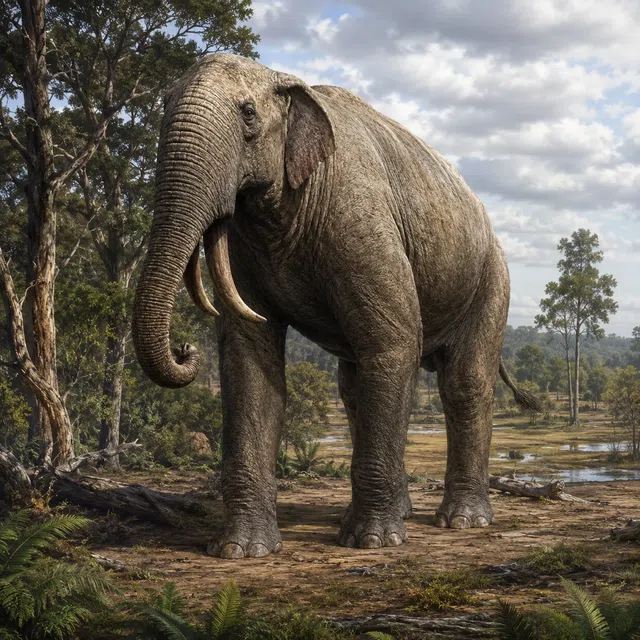
Deinotherium was an extinct proboscidean and one of the most unusual relatives of today's elephants. Its most striking feature was two large tusks set firmly in its lower jaw. They initially ran downwards and then curved backwards. However, Deinotherium had no comparable tusks in the upper jaw. It is precisely this anatomy that has historically led to misinterpretations. The Mainz Natural History Museum reports that only the discovery of a complete lower jaw showed how the unusual tusks were actually arranged. Deinotheria belonged to an early successful branch of the proboscis (Proboscidea). They lived over a very long period of time from the Miocene to the early Pleistocene and were found in Africa, Europe and Asia. Exactly what the downwardly curved tusks were used for cannot be conclusively proven. A commonly held hypothesis is that Deinotherium used it, for example, to remove tree bark or tear out aquatic plants.
The conspicuous tusks of Deinotherium were located in the lower jaw and were curved downwards and backwards.