History - Inventions and discoveries - Stethoscopes - Medical diagnostics - France - History of inventions
Which French doctor invented the stethoscope in 1816?

Correct!
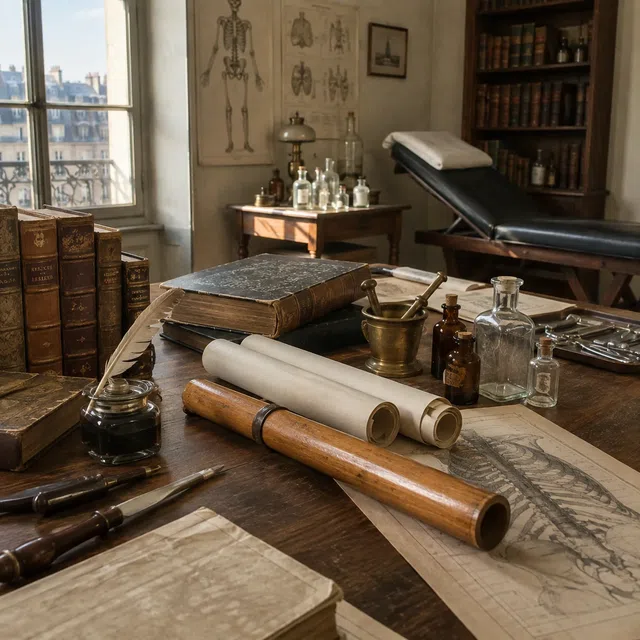
The French doctor René Théophile Hyacinthe Laënnec invented the stethoscope in 1816 and thereby founded the so-called indirect auscultation - that is, listening to the body using an instrument instead of placing the ear directly on the chest. The decisive moment occurred during the examination of a young patient with suspected heart disease. Remembering that sound can be transmitted through solid or tube-like objects, Laënnec rolled paper into a hollow cylinder and placed one end on the patient's chest. At the other end he could hear the heartbeat much more clearly. Laënnec then developed a wooden stethoscope from this simple paper tube. He used his instrument to systematically examine heart and lung sounds and was able to connect numerous sound phenomena with the underlying diseases. In 1819 he published his findings in his important work De l'Auscultation Médiate. The new examination method then spread quickly in medicine and became a cornerstone of physical diagnostics.
René Théophile Hyacinthe Laënnec invented the stethoscope in 1816 and founded indirect auscultation.