History - Inventions and discoveries - Photography - Cameras - France - History of inventions

Which French inventor created the oldest surviving photograph taken with a camera in 1827?

Correct!
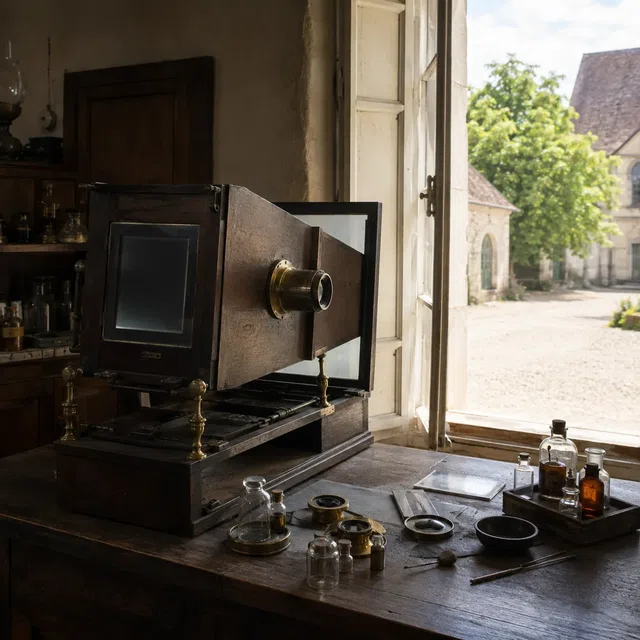
The French inventor Joseph Nicéphore Niépce experimented with using light to permanently capture images as early as the 1810s. He called his process Héliography - “solar writing”. In 1827, the famous picture “View from the Window at Le Gras” was created on his estate Le Gras in Burgundy. It shows buildings, trees and the courtyard that Niépce photographed from a window in his study. The Harry Ransom Center describes it as the earliest surviving photograph produced using a camera obscura. To do this, Niépce coated a tin plate with light-sensitive bitumen and inserted it into a camera obscura. The necessary exposure time was enormous and, according to today's description from the Harry Ransom Center, lasted several days. In 1829, Joseph Nicéphore Niépce joined forces with Louis Jacques Mandé Daguerre. After Niépce's death in 1833, Daguerre further developed the technique and presented the much more practical daguerreotype in 1839, which subsequently triggered the worldwide spread of photography. That’s why the simplified question is “Who invented photography?” historically not completely clear. However, for the oldest surviving permanent camera photography, Joseph Nicéphore Niépce is the clear answer.
Joseph Nicéphore Niépce created the oldest surviving photograph taken with a camera in 1827.