
History - Inventions and discoveries - Writing systems - Accessibility - France - History of inventions

As a teenager, which Frenchman developed the writing system consisting of six raised dots that is now used by blind people around the world?

Correct!
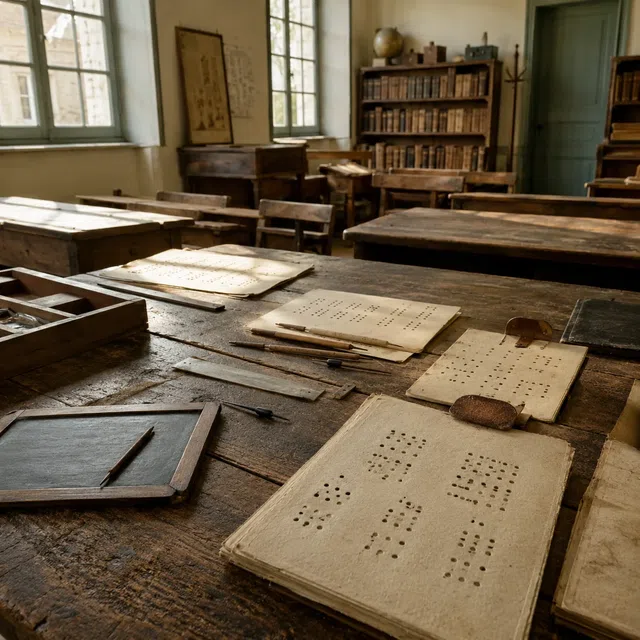
As a student at the Paris Institute for Blind Youth, Louis Braille developed a novel writing system consisting of combinations of six raised dots. A complete Braille cell has two columns, each with three possible points. Numerous character combinations can be created from this. Louis Braille received his decisive inspiration from Charles Barbier, a former French artillery officer. Barbier had developed a so-called “night writing” system that soldiers could use to read messages using raised dots, even in the dark. However, his system used twelve points and was comparatively complicated. Louis Braille recognized the potential of the idea and, as a student, developed a much simpler system. The Library of Congress describes the crucial advance like this: Braille reduced the size of the cell to six dots, so that a finger could grasp the entire unit with a touch. In 1829 he published a detailed description of his method for the first time. Braille could represent not only letters, but also numbers, punctuation marks, mathematical symbols and musical notes. After Louis Braille's death in 1852, his system became increasingly widespread internationally. In 1878, a congress in Paris decided to adopt Braille as the international writing system for blind people.
Louis Braille developed the writing system of six raised dots used worldwide.