Animals - Animal types and traits - Oceans - Fish

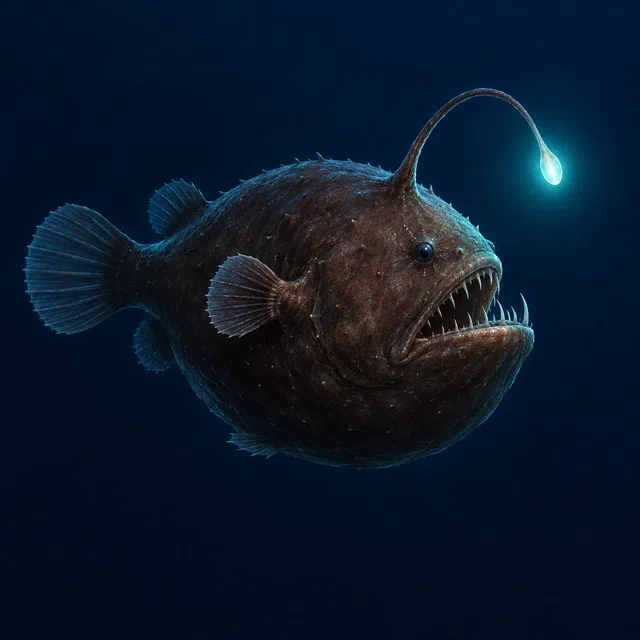
Female deep-sea anglerfish have a glowing organ at the tip of a projection on their forehead. What is this light mainly used for?

Correct!
The light acts as a lure, drawing other animals close to the anglerfish’s mouth. When a small fish or another prey animal comes close enough, the waiting predator can snap it up. This means it does not have to keep swimming through the darkness in pursuit of food. The projection on the head is a modified dorsal-fin ray. At its tip is the glowing organ, called the esca. In the female deep-sea anglerfish described here, light-producing bacteria live inside it. Their glow is an example of bioluminescence: light produced by chemical processes in living organisms. The position of the glowing organ directly in front of the large mouth makes the trick particularly effective. An animal can approach the conspicuous light while the predator’s dark body remains hard to see in the background. The name anglerfish is therefore fitting: instead of using a hook and line, the fish catches food with a glowing lure. The familiar glowing projection belongs to females of certain deep-sea anglerfish. Their much smaller males have no such glowing esca. Females also vary between species: the shape and appearance of the projection can differ considerably.