Nature and environment - Geology and natural phenomena - Volcanoes - Geology

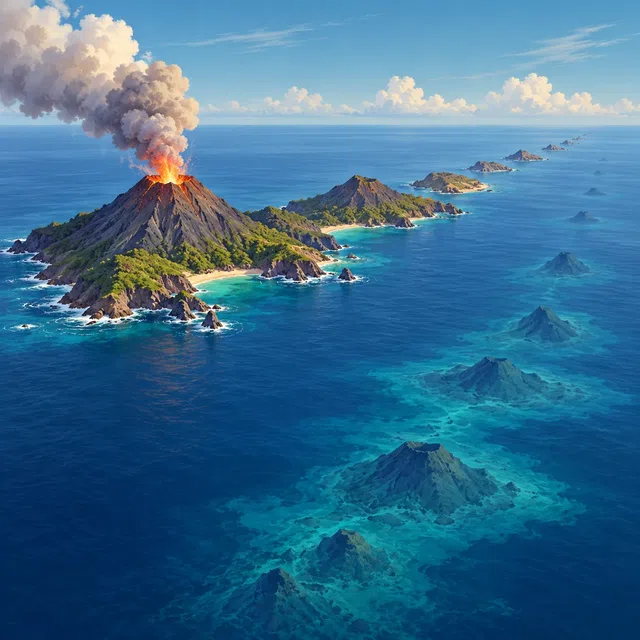
How can a long chain of islands and seamounts form above a relatively stationary volcanic hotspot?

Correct!
As a tectonic plate moves over a comparatively stationary hotspot, new volcanoes can form one after another. The plate carries older volcanoes away from the region of strongest magma supply. Over time, this produces a chain of islands and seamounts. The Hawaiian chain is a familiar example. Its age pattern broadly shows older volcanoes farther from the present active zone. As distance increases, the main activity can diminish, while erosion and subsidence alter the older volcanic structures. Relatively stationary is a simplification, not an absolute law of nature. Hotspots can also move over geological time. The basic model depends on the plate shifting relative to its magma source; the islands do not float independently like ships on the sea.