Dinosaurs & Prehistory - Prehistoric marine predators - Dunkleosteus - Placoderms - Devonian - Prehistoric fish
What did Dunkelosteus have instead of real teeth?

Correct!
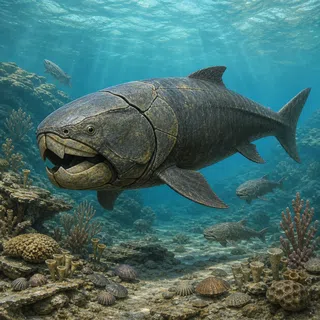
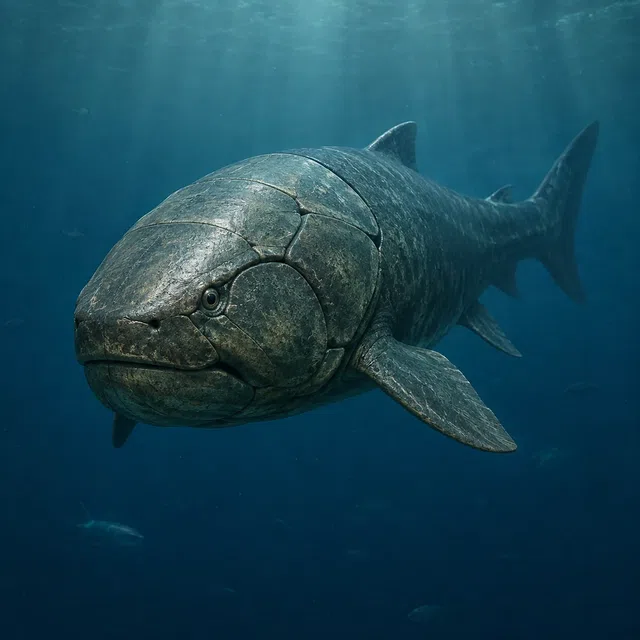
Dunkelosteus terrelli was a massive predatory armored fish that lived in the seas during the Late Devonian, more than 350 million years ago. It belonged to the placoderms, an early group of jawed vertebrates. However, his fearsome mouth is deceptive: Dunkelosteus had no real teeth. Instead, parts of his jawbone formed large, razor-sharp cutting edges. The Cleveland Museum of Natural History specifically describes these jaws as blade-like bony structures that sharpened each other as the mouth opened and closed. This caused the upper and lower jaws to function a bit like huge scissors. Recent anatomical research re-examines these unusual, hatchet-like jaw structures and confirms that Dunkelosteus had a highly specialized chewing apparatus that was distinctly different from the teeth of modern sharks or predatory fish. Its appearance cannot be completely reconstructed either: the heavily ossified and armored areas of the skull and front body are particularly preserved as fossils, while the rear body is much less known. That's why scientific reconstructions of Dunkelosteus have changed significantly in recent years.
Dunkelosteus had no real teeth, but rather sharp-edged bone plates or jawbones with cutting edges.