Animals - Animal types and traits - Geckos - Lizards - Reptiles - Animal anatomy
Why can geckos walk on walls and even ceilings?

Correct!
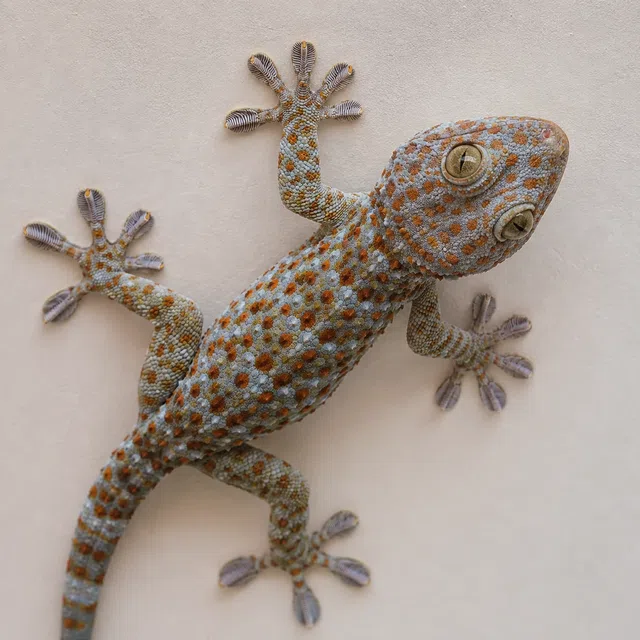
The feet of many geckos are covered with enormous numbers of microscopic hairs called setae. The Tokay gecko has hundreds of thousands of them on its feet. Each individual hair branches into numerous even smaller, spatula-shaped end structures. These tiny structures come so close to a surface that weak van der Waals forces can act between the molecules. A single one of these interactions is tiny, but millions of contact points acting simultaneously create enough adhesive force for a gecko to even hang upside down on a smooth surface. Experiments confirmed van der Waals forces as the central mechanism of dry gecko adhesion. Geckos don't need glue or suction cups for this. To remove them, they change the angle of their toes and roll or peel the hairs off the surface. This means they can run very quickly despite the strong grip. What is particularly astonishing is that this adhesive system even has a certain self-cleaning ability: studies show that dirt particles can be removed from the adhesive structures during repeated contact.
Gecko adhesion works dry and relies on millions of tiny contact points on the toes.