Animals - Animal types and traits - Platypuses - Animal reproduction

Why does the platypus lay eggs even though it is a mammal?

Correct!
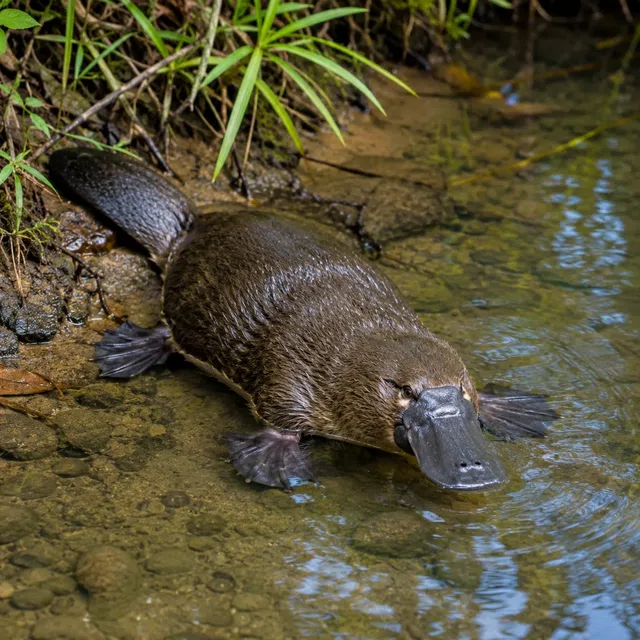
The platypus (Ornithorhynchus anatinus) is actually a mammal - and still lays eggs. It belongs to the so-called monotremes or monotremes, a very old evolutionary line of mammals. The monotremes living today – platypuses and echidnas – are the only mammals still in existence that reproduce through eggs. Egg-laying is not an indication that platypuses are half-bird or half-reptile. Rather, monotremes retained this original reproductive trait of their early mammalian ancestors over the course of evolution, while live birth evolved in the remaining mammalian lineages. A female platypus typically lays one to three soft-shelled eggs, usually two. During the breeding season, the female curls up and holds the eggs against her stomach with her tail. The young hatch after about ten to eleven days. And this clearly shows that the platypus is a mammal: the mother then feeds her young with milk. However, platypuses do not have teats. The milk comes out through special areas of the skin and is absorbed by the young animals. The platypus combines features that at first glance appear to come from completely different groups of animals.
Platypuses are egg-laying mammals: they retain an original reproductive characteristic and still feed their young with milk.