Cars and mobility - Mobility history - Rack railroads - Mountain railroads

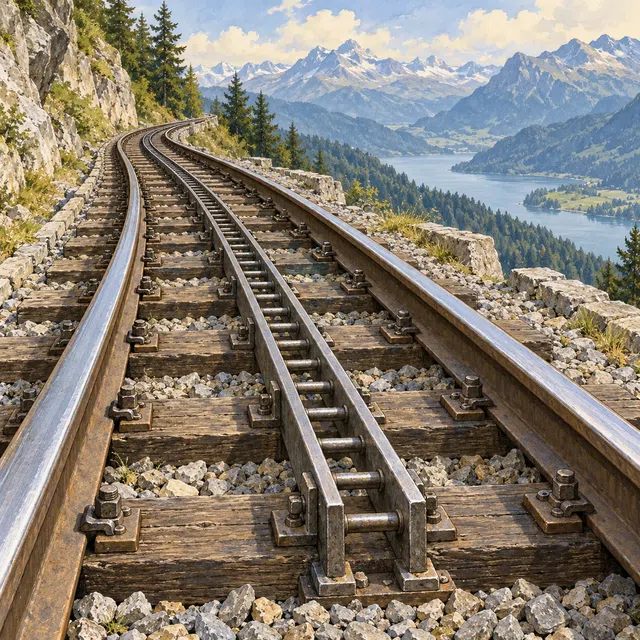
Why was a rack rail installed between the running rails of a mountain rack railroad?

Correct!
The vehicle’s cogwheel engages with the fixed rack rail. This toothed engagement can transmit forces when the adhesion of ordinary wheels on smooth rails is insufficient for a steep route. It is also used in suitable braking systems. Rack railroads made new mountain routes possible in the 19th century. The Riggenbach system, for example, has a ladder-shaped rack and entered service on the Vitznau–Rigi Railway in 1871. Other systems with differently shaped racks were also developed. The running rails still guide and support the vehicle. The rack supplements them with a positive mechanical engagement. It is neither a third running rail for ordinary wheels nor a mechanism for changing track gauge. The gearing and braking equipment used depend on the particular railroad.