Nature and environment - Seas and waters - Oceans - Geology

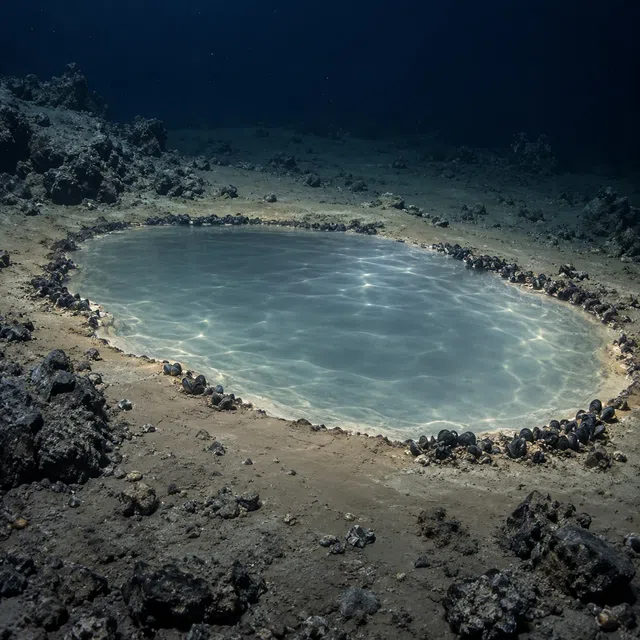
Depressions in the deep seafloor sometimes contain pools that look like underwater lakes. How does their liquid differ from the surrounding seawater?

Correct!
The liquid in these underwater pools is particularly salty water, also called brine. Its high content of dissolved salts makes it denser than the surrounding seawater. It can therefore flow along the seafloor and collect in depressions. A visible interface forms between ordinary seawater and the concentrated brine. It makes the pool look like a small lake with its own surface and shoreline. Disturbances can even create waves there. Above this surface, however, there is still seawater rather than air. Density describes how much mass occupies a given volume. A liter of concentrated brine has more mass than a liter of the surrounding seawater. The denser liquid therefore lies below. The interface is not a solid skin or an impermeable wall; the layering does not mean that mixing is fundamentally impossible. The salt can come from ancient salt deposits beneath the seafloor. If it rises dissolved in water, it can supply these pools. These apparent underwater lakes thus demonstrate an interaction between geological processes and the properties of water.