Dinosaurs & Prehistory - Other prehistoric animals - Quinkana - Crocodyliformes - Reptiles - Extinct animals
How did the teeth of most Quinkana species differ from those of many modern crocodilians?

Correct!
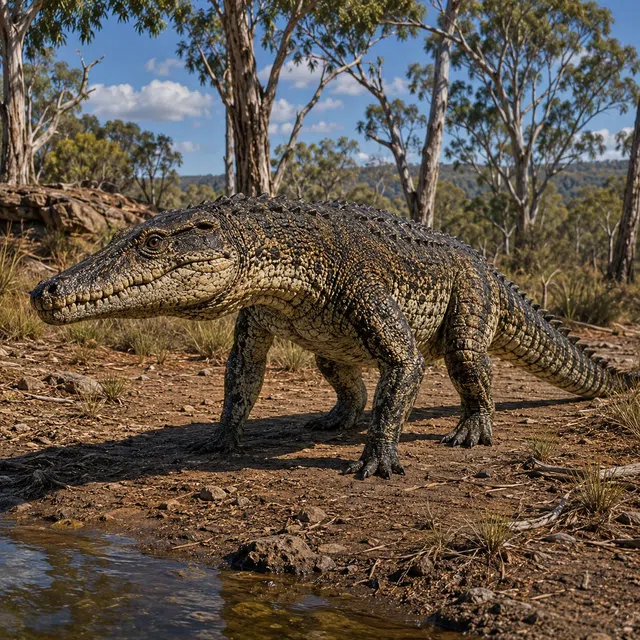
Quinkana was an extinct Australian relative of crocodiles belonging to the mekosuchines. Most species had especially distinctive ziphodont teeth: they were laterally compressed and had serrated cutting edges, more like small meat knives than the conical gripping teeth of many living crocodilians. This tooth shape is directly documented in the fossil record. Quinkana meboldi was an exception because the edges of its teeth lacked serrations. Ziphodont dentition is consistent with a predatory lifestyle in which the teeth could actually slice flesh. The Queensland Museum accordingly describes Quinkana as a carnivore with sharp, blade-like teeth. Quinkana is also often reconstructed as an unusually terrestrial crocodilian relative. Fossils found in caves and other anatomical features are considered evidence of a land-based lifestyle, although the precise extent of that lifestyle is scientifically less certain than the shape of the teeth. Some Quinkana species reached considerable sizes. The Queensland Museum cites a possible maximum length of about 5 to 6 meters, while popular reconstructions sometimes propose even greater lengths.
Most Quinkana species had laterally compressed teeth with serrated cutting edges; Quinkana meboldi was a known exception whose teeth lacked those serrations.