Dinosaurs & Prehistory - Fossils & Earth history - Andrewsarchus - Mammals - Fossils - Eocene
What is particularly remarkable about the known fossils of Andrewsarchus?

Correct!
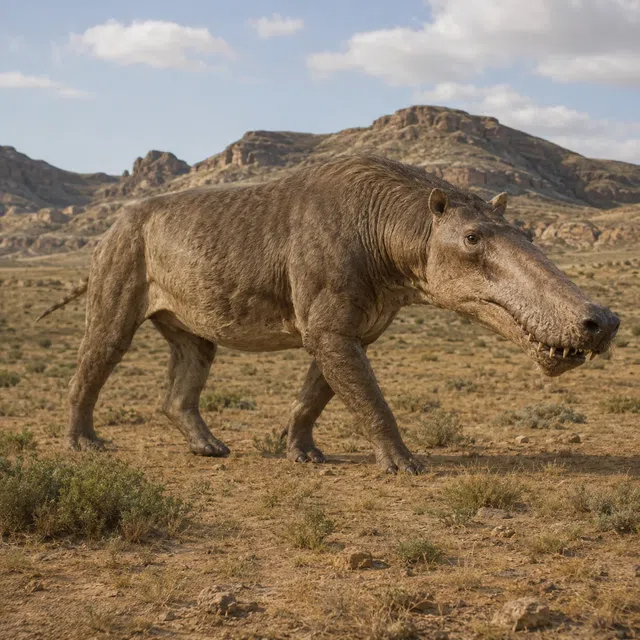
Andrewsarchus mongoliensis is one of the most mysterious large mammals in Earth's history. By far its most complete and important fossil was discovered in Inner Mongolia in 1923: an enormous skull about 83 centimeters long. More recent reports mention only a few additional jaw fragments and teeth; no bones from the rest of the body have yet been securely attributed to the animal. This means that every familiar full-body depiction of Andrewsarchus is necessarily a reconstruction. Its shoulder height, body length, legs, and overall build have been inferred from the skull and comparisons with mammals thought to be related. In an older reconstruction, the American Museum of Natural History estimated a shoulder height of about 1.8 meters and a body length of 3.5 meters. These figures are now considered highly uncertain, however, because no bones from the rest of the body have been found and ideas about its relationships have changed. Its classification has also changed considerably over time. Andrewsarchus was once regarded as a giant mesonychid. More recent analyses instead place it among relatives of the even-toed ungulates; a 2023 study suggests a closer relationship to the extinct entelodonts. Its precise position nevertheless remains uncertain because the fossil evidence is so incomplete. That is why claims such as “the largest predatory land mammal of all time” should be treated with caution: both its body size and its exact diet are reconstructed from an animal known almost entirely from skull and tooth material.
A skull about 83 centimeters long is by far the most complete fossil of Andrewsarchus; no bones from the rest of its body have been securely attributed to it.