Dinosaurs & Prehistory - Prehistoric marine predators - Tusoteuthis - Cephalopods - Prehistoric marine life - Cretaceous

Why is the genus Tusoteuthis considered scientifically uncertain today?

Correct!
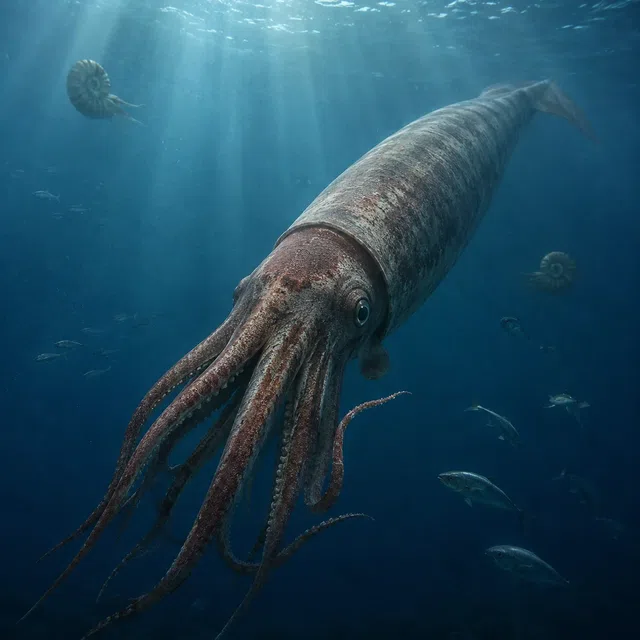
Tusoteuthis is often depicted as a giant "squid" of the Cretaceous period. Scientifically, however, this name is much more problematic than many popular representations suggest. The reason lies primarily in the type specimen: it is incomplete and poorly preserved. As a result, it has too few reliable characteristics to clearly distinguish the genus from closely related fossil cephalopods. A modern revision of the Muensterelloidea therefore concluded that Tusoteuthis is probably a scientifically dubious name. Many fossils previously listed under Tusoteuthis can be better assigned to other genera, particularly Enchoteuthis or related forms. There is also a common misunderstanding: Tusoteuthis was probably not a true modern squid like today's giant squid. The fossils in question belong to extinct, close-lineage eight-armed cephalopods. So they were more closely related to the octopus evolutionary line than to true squids in the strict sense. That doesn't make Tusoteuthis any less exciting, but it does show why paleontological names need to be used carefully. If the fossil bearing the name is too poorly preserved, a spectacular name can become scientifically uncertain.
Tusoteuthis is considered uncertain because the type specimen is poorly preserved and provides too few clear features for stable delimitation.