Dinosaurs & Prehistory - Dinosaurs - Iguanodon - Dinosaur anatomy - Cretaceous
Where was the famous Iguanodon thumbthorn incorrectly placed in early reconstructions?

Correct!
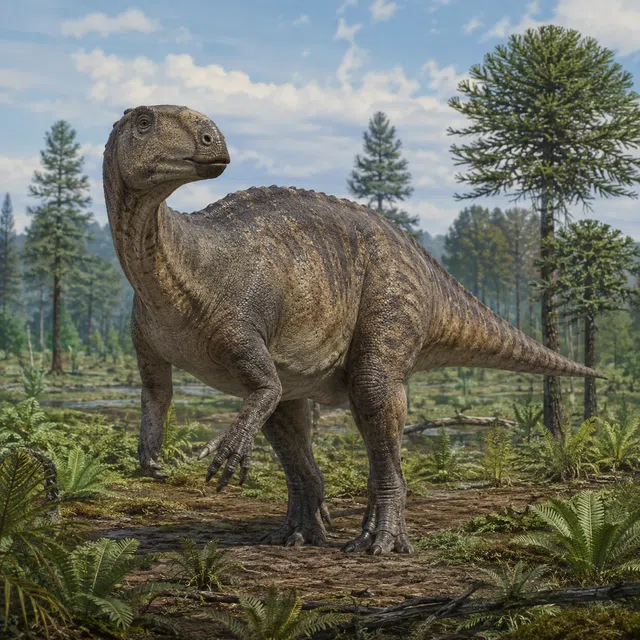
Iguanodon was among the first dinosaurs to be scientifically described. Among the early fossils was a large, cone-shaped bone whose exact location on the body was initially unknown. Early researchers interpreted it as a nasal horn and therefore sometimes depicted Iguanodon as similar to a rhinoceros. Only after the spectacular discovery of numerous, much more complete Iguanodon skeletons in Bernissart, Belgium in 1878 did it become clear that this supposed horn bone actually belonged to the hand: Iguanodon had a large thumb thorn on each hand. The exact function of these thorns is not completely certain. It can be used to defend against predators, fight with other animals or even manipulate plants. In life, the bony tips were also probably covered in keratin, making them even larger and sharper than the preserved fossils. The famous Iguanodon statues in Crystal Palace Park in London still show the historical misinterpretation with a horn on its nose, making it a beautiful example of how dinosaur reconstructions can be changed by new fossil discoveries.
In early reconstructions, the Iguanodon's later thumbthorn was incorrectly located on its nose. More complete finds from Bernissart showed that it belonged to the hand.