Dinosaurs & Prehistory - Other prehistoric animals - Elasmotherium - Rhinocerotoids - Pleistocene - Extinct animals

Which famous feature of Elasmotherium has not yet been directly preserved in fossils?

Correct!
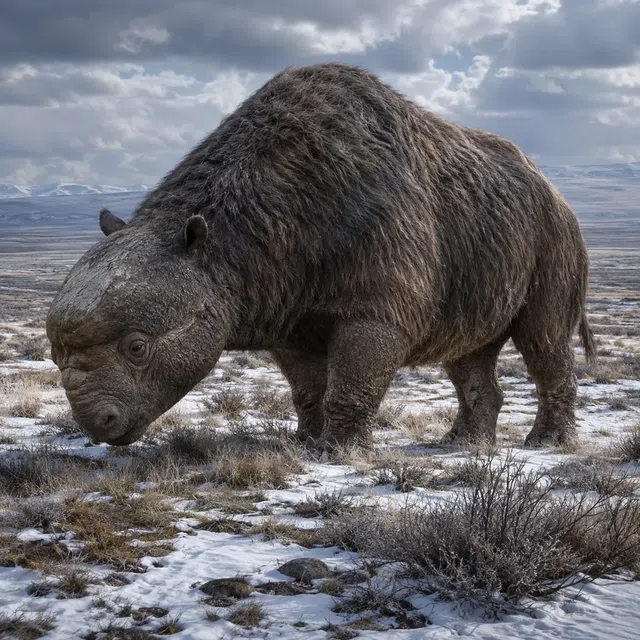
Elasmotherium sibiricum, often referred to as the "Siberian unicorn", was a giant extinct rhinoceros of Eurasia. It could weigh about 3.5 tons and lived in open, dry steppe landscapes. Surprisingly, according to modern radiocarbon dating, the species survived until at least around 39,000 years ago. Elasmotherium is particularly famous for depictions with an enormous single horn on its forehead. But such a horn has never been found in fossil form. This isn't particularly surprising, as rhinoceros horns are mainly made of keratin and only rarely fossilize. However, there is a noticeable large bony elevation on the skull. This was traditionally interpreted as a starting point for a horn. However, how big this horn actually was - or what exactly the structure looked like on the outside - is not known for certain. The Natural History Museum therefore cautiously states that Elasmotherium may have had a large single horn. The term “Siberian unicorn” should therefore not be taken too literally: the animal itself has excellent fossil evidence, but its iconic horn is a reconstruction based on the skull anatomy.
The famous large horn of Elasmotherium has not yet been preserved directly as a fossil, but is inferred from the skull anatomy.