Dinosaurs & Prehistory - Fossils & Earth history - Rhyniognatha - Arthropods - Fossils - Devonian
Why is the scientific classification of Rhyniognatha still uncertain today?

Correct!
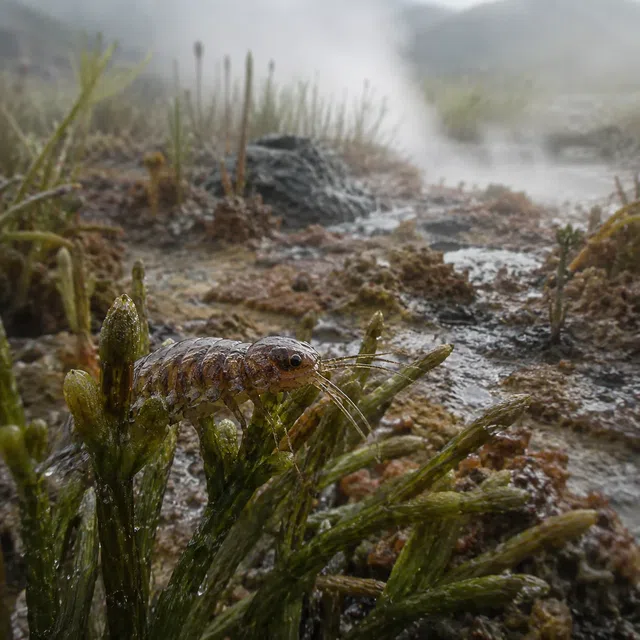
Rhyniognatha hirsti is one of the most enigmatic fossils from the early history of land arthropods. The only known specimen comes from the famous Rhynie Chert in Scotland and is around 400 million years old. Mainly mouthparts or mandibles and some structures of the head area that are difficult to interpret are preserved - not a complete animal. In 2004, Michael Engel and David Grimaldi re-examined the fossil and interpreted its jaws as typical of real insects. They even concluded that Rhyniognatha may already have belonged to a relatively advanced group within insects. This made the fossil widely known as the oldest known true insect. But in 2017, Carolin Haug and Joachim Haug re-examined the tiny fossil using modern imaging methods. Their reconstruction showed that several structures could also fit well with myriapods, i.e. the relatives of centipedes and millipedes. According to their interpretation, it is even more likely that it belongs to a myriapod - but they could not completely rule out that it belongs to an insect. That's why today we shouldn't simply claim: "Rhyniognatha was the oldest flying insect." Scientifically cleaner: Rhyniognatha is an arthropod find around 400 million years old, whose exact systematic position remains controversial. Recent work on the early evolution of insect flight also explicitly points to this uncertainty. This makes Rhyniognatha even more interesting for a quiz question: the fossil is real - but we don't even know for sure what kind of animal it was.
Rhyniognatha is only very incompletely preserved; its characteristics allow for both insect and myriapod interpretations.