Dinosaurs & Prehistory - Other prehistoric animals - Thylacoleo - Australian megafauna - Pleistocene - Extinct animals
To which animals living today was Thylacoleo evolutionarily closer than real lions?

Correct!
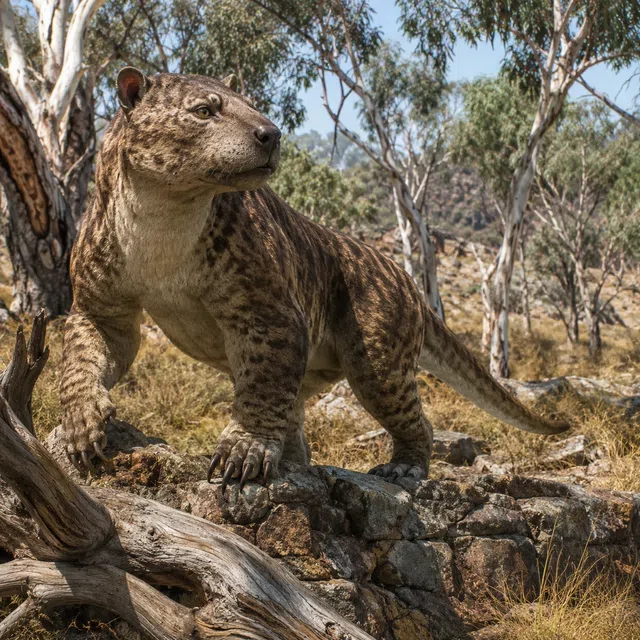
Despite its name, Thylacoleo carnifex, the so-called “marsupial lion,” was not a cat at all. It was an Australian marsupial and belonged to the Vombatiformes within the Diprotodontia. The only living representatives of this major evolutionary lineage today are wombats and koalas. Thylacoleo was ecologically extremely different from its predominantly herbivorous relatives. It was a highly specialized carnivore and is considered the largest known carnivorous marsupial mammal in Australia. His teeth were exceptional. Instead of typical large canine teeth, Thylacoleo had enlarged incisors and enormous blade-like premolars that worked against each other like large scissors when biting. His forelimbs were also unusually strong. Fossil anatomy suggests that Thylacoleo was able to grasp prey using its strong arms and large claws. Studies of the body's skeleton also indicate that he could at least climb well. The name Thylacoleo roughly means “marsupial lion”. However, the similarity to a lion is an example of convergent evolution: two mammalian lineages that are far apart from each other independently developed adaptations to a predatory lifestyle.
Thylacoleo was not a true lion, but an Australian marsupial from the vombatiform lineage, whose modern representatives are wombats and koalas.